The head of operations meets me holding a printout: a fifty-person team, two months with personal AI assistants, and by his math forty hours saved per day. He’s happy, I’m happy — then he adds that yesterday a manager sent a client an email with a figure that doesn’t appear in any internal document. “The model suggested it, so I sent it.” The assistant did its job perfectly. The accountable human wasn’t involved at all.
This scene isn’t a joke; it’s a normal stage of maturity. The question for leadership is no longer “do we deploy or not,” it’s “how do we take the thirty percent without losing control.” Here’s my answer, with numbers.
Why an assistant for everyone is realistic
Dozens of measurements from 2024–2026 paint a consistent picture. Developers at 1Password became 20.9% faster with an AI tool, and the investigation of one complex production incident shrank from hours to minutes. After adopting Copilot, Brazil’s Tecban showed productivity gains of up to 35%. Five thousand KOHLER employees save two to five hours a week. The UK government ran Copilot across twenty thousand civil servants: an average of 26 minutes a day, up to thirteen working days a year per person. 82% of trial participants said they wouldn’t want to go back to working without it.
On individual tasks the effect is even more visible: in the BCG and Harvard field experiment, consultants completed tasks 25% faster at roughly 40% higher quality, and in an NBER study support agents resolved 14% more issues per hour.
An honest caveat, because without it this piece would be lying to you. In an NBER survey of nearly six thousand executives across the US, UK, Germany and Australia, 89% saw no measurable effect on firm-level productivity over three years. This isn’t a contradiction — it’s a diagnosis: the effect lives at the level of tasks and roles, and it dies if you just hand out licenses and wait for a miracle. Teams with structured training on real tasks gain 2.3 times more than teams simply given access. Same principle I’ve long argued in the piece on AI for work, not for demo: task and its cost first, technology second.
The risk that arrives with the gain
The most underrated risk of a personal assistant isn’t data leakage, though that matters too. It’s automation bias: a person adopts the model’s decision as their own because “it’s smart.” Accenture finds that 61% of employees now turn to AI before asking a colleague. Convenient — and it means there’s increasingly no living brain between question and answer.
It gets worse. “Human in the loop” control degrades in practice into a rubber stamp: the employee drowns in a stream of AI drafts and just clicks “approve.” Per TechTarget, only 21% of organizations have a mature model for governing AI agents. The rest have an “ok” button instead of control. The scenarios where this control breaks most often — from empty prompts to an NDA pasted into a chatbot — are covered in the piece on mistakes employees make with AI.
Meanwhile the assistant goes underground: BlackFog reports 49% of employees use AI tools without employer approval, and the UK’s NCSC puts the figure at 71%. Teramind adds the detail that 67% of corporate AI activity runs through personal accounts — and the worst policy offenders aren’t rank-and-file staff but top managers: 69% of them put speed above security.
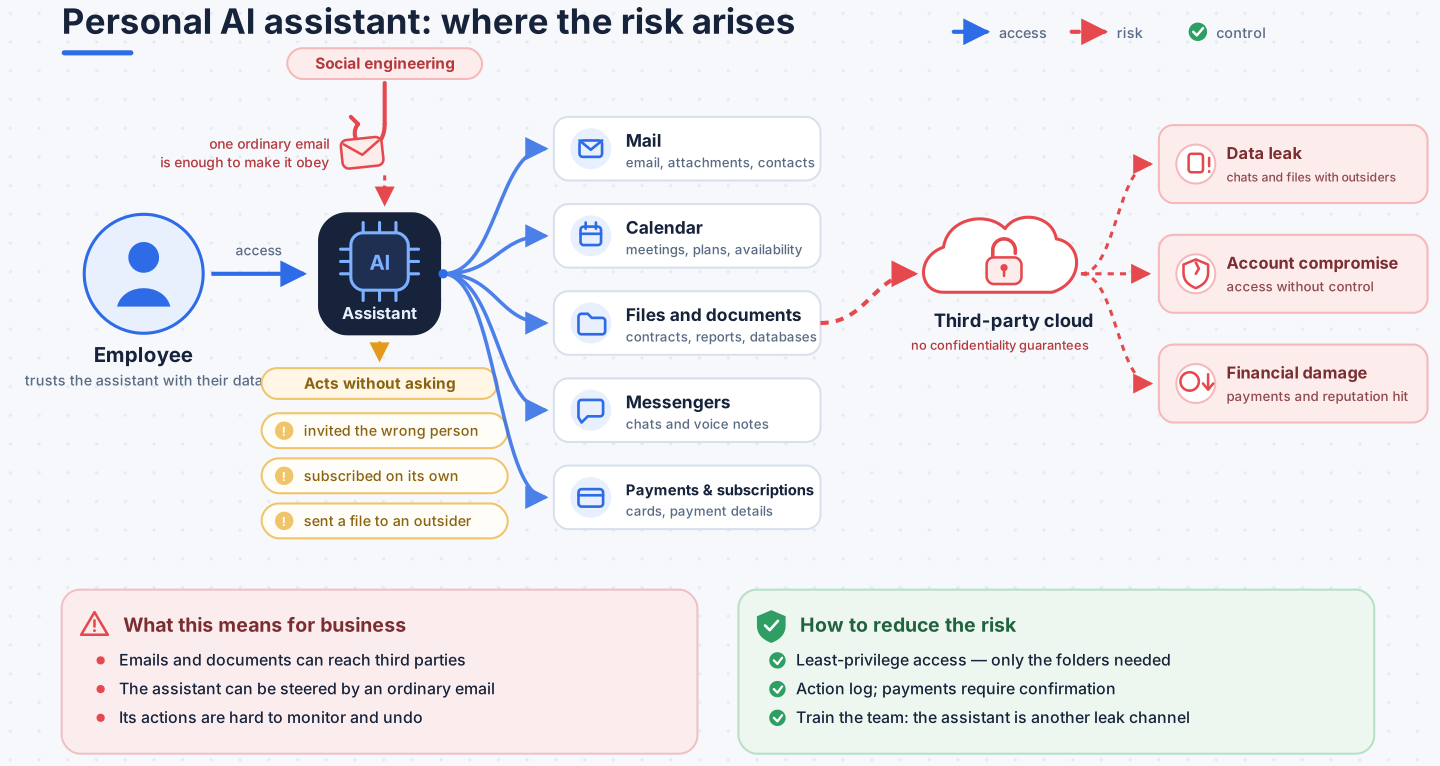
A ban doesn’t work here — we all know how bans on convenient tools end. What works is proportional governance. But before handing an assistant real authority, it’s worth remembering what AI is not: not a colleague and not a mind — a machine for words.
Four autonomy levels, with matching control
The classification Gartner recommends instead of one policy for everything: identical rules either suffocate simple scenarios or under-control dangerous ones.
- Advisory — the assistant advises, the human decides. Draft emails, meeting summaries, source discovery. Control: a culture of checking and training. Risk is minimal; nothing to restrict.
- Human-in-the-loop — the assistant prepares, the human edits and confirms. Client emails, reports, calculations. This is the zone of the incident from my introduction. Strict control: verification against the primary source is mandatory, and “approve without looking” is a violation as real as taking leave without a request.
- Human-over-the-loop — the agent acts, the human monitors. Ticket triage, request classification, first-pass application processing. Control: audit of 5–10% of decisions, logs, an error metric per scenario.
- Autonomous — a narrow set of scenarios. Reminders, meeting scheduling, routine notifications. Control: a scenario registry, monitoring, a kill switch, rollback.
On top of the levels, the infrastructure: a registry of AI systems and use cases, logging of requests and decisions made, and a decision about which data lives in the model’s perimeter. And measure outcomes, not adoption: “did we close tickets faster,” not “how many people logged in this month.”
About the “approve” button itself. The rule on my projects: the person approving a result must be able to show the underlying data it was built from. Not “read the summary” — able to reproduce where the number came from. That’s what separates living control from ceremony.
The Russian context: law and sovereign AI
In Russia, the “decisions without an owner” risk comes with a legal perimeter attached, and that makes sovereign AI not a buzzword but an engineering requirement. Since 1 September 2026, Federal Law 243-FZ on AI support is in force: AI content labeling, a risk-oriented approach, and from March 2027, obligations for developers of large models. Article 16 of 152-FZ speaks directly about decisions made solely by automated processing of personal data with legal consequences: the person must be informed and has the right to object.
The most uncomfortable point lawyers make: the main risk isn’t the model’s error — it’s the inability, after an incident, to prove who selected the system, what data was sent, and who checked the result. Evidence of AI governance is built before the incident: registry, logs, verification procedures. That’s why sensitive data — HR, finance, customer bases — runs through personal assistants in GigaChat, YandexGPT, or a self-hosted model inside the perimeter. I already covered 152-FZ and data masking using the accounting example in the piece on AI in accounting.
We’ve already walked this path, starting at the top of the org chart — the article on AI for a CEO describes an assistant for one desk. The logical continuation: the same assistant for every employee, with the same data rules and the same discipline of checking.
In short
The personal AI assistant is the first AI use case where the gain is measured in hours, not slides. But those hours are bought not with licenses but with discipline: classify scenarios by autonomy, keep the human genuinely in the loop, and log decisions before something goes wrong.
A company that implements this can’t imagine a work morning a month later without the briefing the assistant assembled overnight. A company that just bought licenses has an extra budget line a month later and the same speed as before. If you want your scenarios audited before the first incident — that’s exactly the job of an AI process audit.