There’s a persistent stereotype: AI is for developers, marketers and call centres. A CEO, the thinking goes, has different concerns — strategy, people, money. Here’s the thing: those three areas are exactly where AI pays off today. Not as a “two-year digital transformation”, but as concrete hours that come back this week.
I’m writing this as someone who has been deploying AI in companies since 2017 — and uses it daily himself. The principle is the one I described in AI for work, not for demo: the task and its cost first, the technology second. Here are four CEO jobs where AI already delivers measurable results.
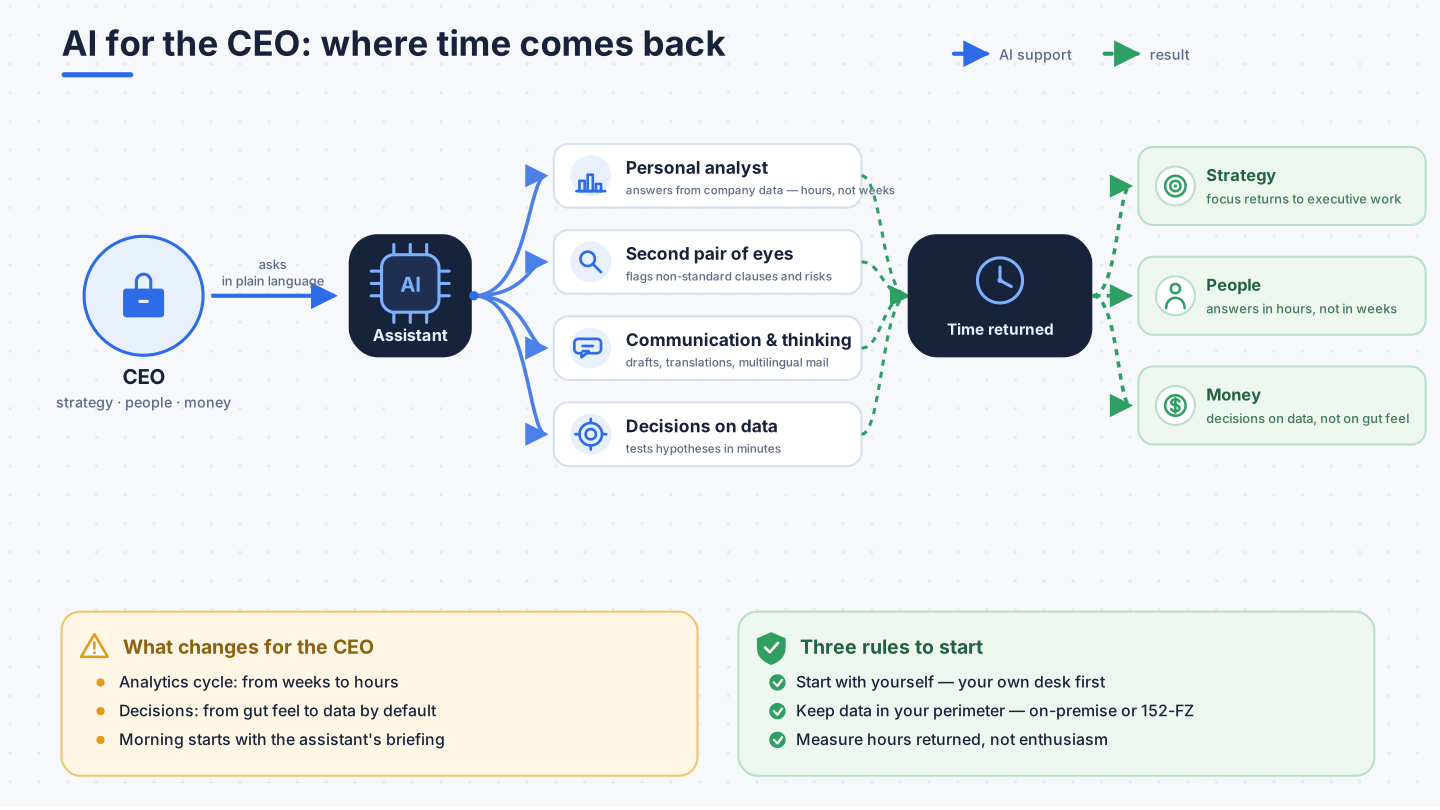
First: a personal analyst over company data
A CEO makes decisions in meetings, and meetings run on data. The classic cycle: ask finance or analysts for a report, wait, get a spreadsheet, ask a follow-up question, wait again. From question to answer — days.
The working alternative I built at an investment fund: a RAG pipeline over the company’s internal documents — reports, minutes, CRM, financial models. The CEO asks a question in plain language — “which projects are more than two weeks behind and why” — and gets an answer with links to sources. Not the model’s opinion, but an excerpt from the company’s own data.
The effect at that fund: the analytics cycle shrank from weeks to hours. Not because the model is magic, but because the waiting between question and data was removed.
Second: a second pair of eyes on documents
A forty-page contract to sign. An auditor’s report. Deal terms. A CEO reads all of it personally — rightly so, it’s their signature. But reading forty pages of legal text “head-on” at the end of a working day means reading them badly.
Here AI doesn’t replace the lawyer — it does a first pass: flags non-standard clauses, deviations from template, risky wording, auto-renewing terms. The CEO gets not forty pages but a structured brief: “here are the five places worth a personal look.” The lawyer doesn’t disappear — but their hour is paid for substantive work, not for retelling a document.
Third: communication and thinking
A big part of a CEO’s job is formulation: partner letters, replies to employees, speeches, strategy notes for the board. An AI draft here isn’t “write it for me” — it’s an accelerator: two lines of bullet points in, a coherent text out, which then gets edited into one’s own voice.
Translations and multilingual work deserve a special mention. When a company works with foreign partners or enters new markets, AI holds a working level of business correspondence translation — not literary, but good enough to close a deal. The site you’re reading exists in four languages largely thanks to that.
Fourth: decisions on data, not on gut feel
“I have a feeling sales are slipping” — a phrase that usually hides a month of manual consolidation. A data assistant turns it into a question answered in minutes: where exactly the slump is, since which month, which managers, which products.
The value isn’t that the model is “smarter” than the director. The value is that between hypothesis and check there are minutes instead of weeks — and five hypotheses get tested per meeting instead of one. Decisions start being made on data by default, not by default on intuition.
Where to start
Three rules I give every CEO:
- Start with yourself. The first AI assistant is built not for a department but for your own desk: meeting briefs, contract reviews, drafts. Your example sets the tone for the whole company faster than any memo.
- Keep data in your perimeter. An assistant over company data runs either on-premise or in a Russian cloud — with 152-FZ in mind this isn’t a paranoid’s option but a design norm. Masking before sending to a foreign service is risk reduction, not immunity; details and a function-level example in the breakdown of AI in accounting, the Russian way.
- Measure hours, not enthusiasm. The KPI is simple: how many hours per week came back to you and your team. If the number is zero after a month, the wrong thing was deployed — and it’s good to learn that in a month, not a year.
If you want to scale the assistant from your desk to the whole company, that’s the job a fractional CTO covers for a fraction of a full-time cost. How to scale it without losing control — I covered in the piece on a personal AI assistant for every employee.
In short
AI for a CEO is not about technology. It’s about time returned to strategy, people and money — the three things this job was invented for.
The maturity indicator is simple: in a month, you won’t be able to imagine your morning without the briefing the assistant assembled while you were having coffee. Everything before that — presentations about “AI potential” — can be safely skipped.